The first keynote, delivered by Dr. Sarah Pearson of Brandon University, avoided the jeremiads that often accompany climate talks. "We are not here to be doom-sayers," she told the crowd. "We are here because the scale of change needed is intimate — it happens in backyards, on municipal council agendas and in the fields where kids still learn to set a fence post." Her remarks opened the day not with abstraction, but with this concrete framing: resilience is both ecological and social.
The Gathering stitched together several threads that often remain siloed in Westman: agriculture, urban services and Indigenous stewardship. At one workshop, farmer Tom Sinclair led a small group through a demonstration plot on the river's edge where cover crops and no-till practices now replace a rotational system he once thought immutable. Sinclair, who grew up on these soils, described a careful conversion: "Last year the winter cover kept the moisture. It also kept the gullies from starting. It's not glamorous, but it pays out over three seasons."
Across the estate, a municipal tent hosted a display from the City of Brandon's pilot curbside compost program. Since its inception twelve months ago, the pilot — limited to three neighbourhoods — reports diverting roughly 42 tonnes of organic waste from the landfill, according to a city staffer who presented figures during an afternoon panel. The impact was both statistical and visceral: a volunteer recounted collecting a week’s worth of kitchen scraps from a senior resident and watching her light up when she learned they could be picked up curbside instead of lingering in a freezer for municipal drop-off days.
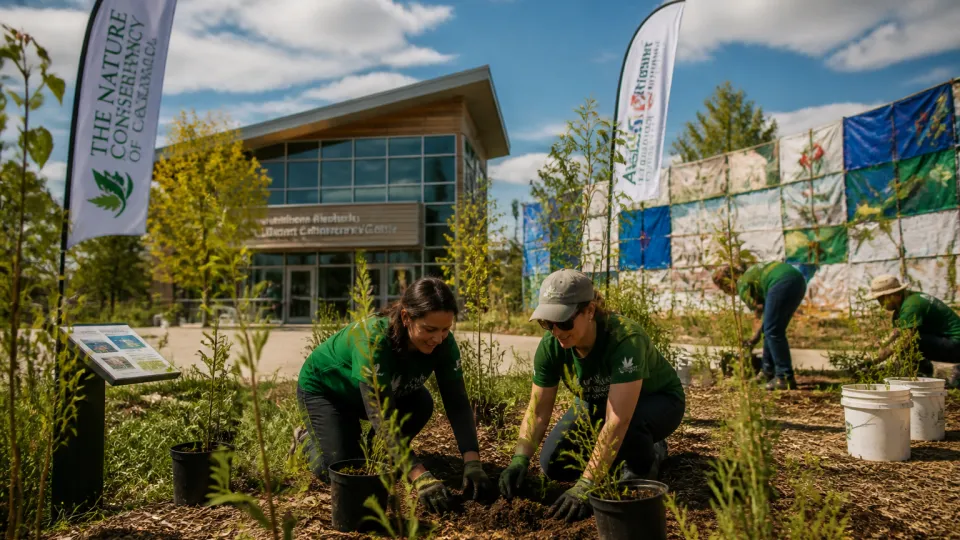
Youth engagement was a throughline. Maya Patel, a 17-year-old organizer with the Brandon Youth Climate Collective, led a hands-on session where teens built pollinator boxes and mapped green corridors on a community GIS. "We want more than sympathy," she said. "We want tools and places to practice what we learn." Several participants later joined a riverside restoration project, planting willows and native prairie species to rebuild the riparian buffer — a small, gritty act of repair that also serves as flood mitigation.
Art and story blended with practice. Across from the plantings, artist Sarah Castillo unveiled an installation made from recycled agricultural tarps and discarded plastic irrigation tubing. Its title — "River Threads" — referenced both the Assiniboine's braided path and the braided economies of rural towns adjusting to market and climate shifts. Castillo's piece drew people into conversation about waste streams, while a neighboring table displayed a prototype community energy co-op prospectus that a group of Brandon homeowners is circulating.
The weekend's heart, however, lay in incremental policy conversations that promised to leave a trace. A roundtable of municipal officials, farmers and nonprofit leaders hashed out a roadmap that included expanding curbside composting city-wide, incentivizing riparian easements on private land, and creating a low-interest loan pool to help households install heat-pump and insulation. Proposals were practical, aimed at lowering the upfront cost of sustainable choices — a persistent barrier in Westman where winter energy bills and farming margins are both unforgiving.
For many attendees, the Gathering crystallized a simple truth: small interventions compound when coordinated. Linda McKinnon, who coordinates volunteer programming at the Riverbank Discovery Centre, pointed to the marquee of local outcomes: new community gardens that doubled food production plots this year, a pilot farm-to-school program supplying produce to elementary cafeterias, and the establishment of a watershed-monitoring volunteer corps that now contributes monthly water-quality readings to provincial databases.
What the weekend did not offer were instant solutions. Instead, it provided scaffolding — shared language, nascent partnerships and a willingness to test ideas in real time. Conversations that might otherwise occur in silos found a common table: a hydrologist discussing beaver-friendly culverts beside a farmer whose neighbor had recently flooded, teenagers sharing mapping apps with elders who remembered old oxbows and natural springs now hidden under hayfields.
Looking forward, participants left with commitments rather than proclamations: a pledge to expand the compost pilot this autumn; an agreement to apply for a joint provincial grant to fund riparian fencing; plans to reconvene as a regional consortium to track cumulative impacts across municipalities.
In the end, the success of the Gathering rested not on grand declarations but on relational infrastructure. In Brandon and the broader Westman region, environmental work is as much about rebuilding trust and institutions as it is about planting trees. The Riverbank's volunteers, farmers, municipal staff and young organizers returned to their routines armed with new contacts and practical next steps. If resilience is indeed intimate, this Gathering demonstrated that the labor of — patient, collaborative and rooted in place — is exactly the kind of work prairie communities are prepared to do.
"We can't buy our way out of every problem," Dr. Pearson reminded the closing circle. "But we can build systems together that make the right choice the easy one."