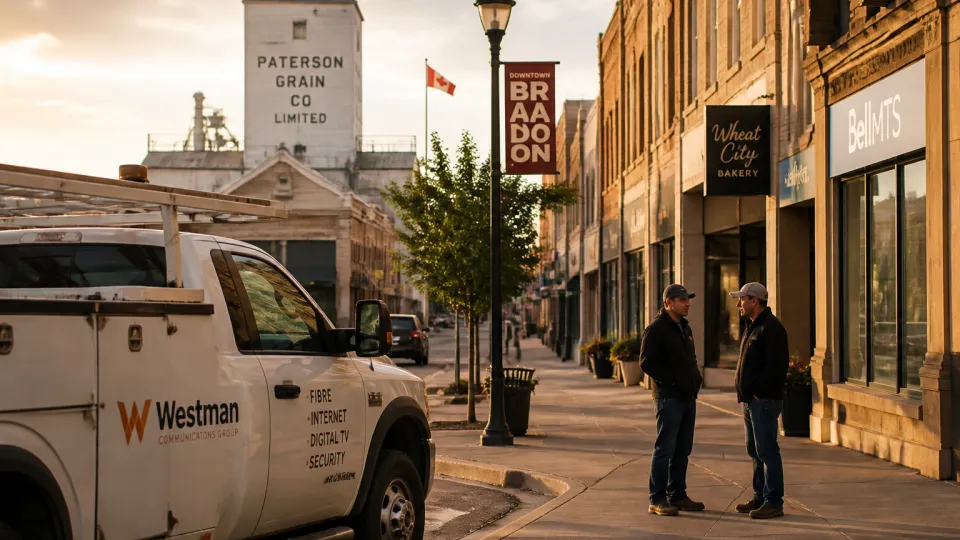
On a cool spring morning outside Brandon, a muddy pickup idles beneath the silhouette of a grain elevator while a fiber-optic crew unspools cable down the same stretch of highway. The scene looks like two eras colliding: one anchored in commodity cycles and neighbourly labour exchanges; the other promising instantaneous data, remote diagnostics, and new markets. That intersection — of soil and signal, tradition and — is the quiet story of Westman business .
The region's economic reinvention did not arrive as a sudden pivot. It grew from decades of local problem-solving and institutions with deep ties. Cooperative movements, credit unions, and federal research stations created an ecosystem that absorbed shocks and translated knowledge into practice. In Brandon, co-operative principles helped farmers aggregate risk and access markets; Westman-based financial institutions kept capital circulating locally; and the Brandon Research Centre bridged scientific insight and prairie realities.
Take agriculture, the backbone that shaped the region's rhythms. Farmers here were early adopters of incremental innovation — no purely theoretical change, but repeated practical experimentation. Precision seeding and variable-rate fertilization moved from university papers into combines after farmers and extension researchers collaborated to adapt equipment to clay loams and late spring frosts. The Brandon Research Centre played a particular role as a place where seed trials, soil studies, and pest management strategies met the hard questions of scale. Its work did not just increase yields; it helped families reduce input costs, stabilize rotations, and plan for a less predictable climate.
Meanwhile, local financial institutions treated community development as part of their mandate. Westoba Credit Union and similar entities took long-term views of prosperity, financing equipment upgrades and supporting local entrepreneurs who banks elsewhere might consider too small or too risky. Those loans built more than balance sheets — they kept a bakery on a town’s main street, enabled a second-generation mechanic to purchase a modern lift, and underpinned modest expansions that multiplied payrolls.
Technology later came to the forefront as both challenge and lifeline. Westman Communications Group and other regional firms invested in broadband infrastructure at a time when digital access often lagged behind urban centres. High-speed connectivity opened doors: telemedicine appointments for rural seniors, e-commerce storefronts for artisans, and agricultural monitoring systems that stream sensor data from a pivot irrigator to a smartphone. For small businesses, that bandwidth was less flashy than a new logo but more transformative: it meant reaching customers beyond postal codes and continuing operations during weather disruptions or global supply chain slowdowns.
The human elements thread through every technological milestone. A third-generation farmer describes the choice to retrofit an older combine with GPS guidance as a family decision — balancing capital constraints, the desire to reduce burnout during harvest, and hope that productivity gains would keep farmland in the family. A café owner in a nearby town remembers pivoting overnight during the pandemic, converting a dining room into a takeout hub, building an online ordering page with help from a neighbour, and hiring back employees as local orders resumed. Those stories are not exceptional; they are the mosaic of risk, cooperation, and improvisation that has defined the region's response to change.
Innovation in Westman has also been quietly democratic. It is not only the preserve of lab coats or venture capitalists. Extension officers, co-op general managers, municipal planners, and entrepreneurs trade ideas in grain elevators, council chambers, and coffee shops. That cross-pollination explains why an agricultural trial can lead to a startup focused on soil sensors, or why a credit union's flexible lending supports a tech pilot that improves local water management.
Looking forward, the region faces familiar and new pressures: climate variability, labour shortages, and the need to diversify while preserving local character. The answer will not be a single breakthrough but continued layering of capacities. Investments in broadband must be paired with training so residents can leverage digital tools. Research must emphasize translational work — co-designed with producers and processors — so innovations travel with the people who will use them. Financial institutions will need to balance prudence and patience, seeding ventures that build resilient supply chains rather than chase quick returns.
What makes Westman unusual, and quietly hopeful, is the social infrastructure that undergirds these changes. Institutions that once organized seasonal grain deliveries now convene conversations about carbon sequestration credits and remote health diagnostics. Community memory — of hardship, mutual aid, and incremental fixes — gives the region a practical imagination. That imagination is not theoretical flair; it is the willingness to try, fail, iterate, and make a small-town ledger or a research plot into the testing ground for a new way of earning a living.
If innovation is ultimately judged by the lives it improves, Westman offers a clear measure: children who can see a future in town instead of moving away, farms that sustain more than one generation, and storefronts where the light stays on into evening. The next chapter will depend on sustaining those institutions and widening the circle of who sits at the table — a project both civic and entrepreneurial, and one the region has quietly been building for generations.