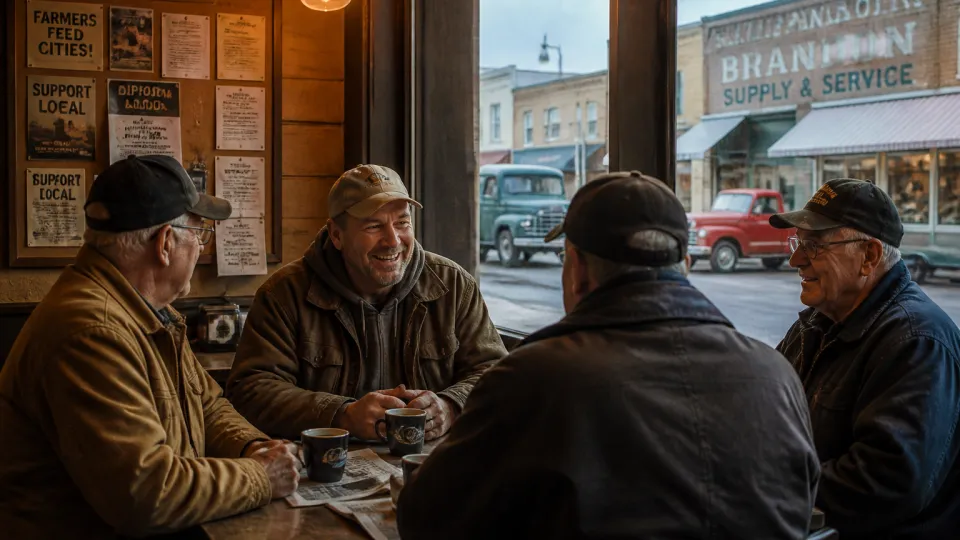
On a December morning in Brandon, the steam from a small roaster fogs the window of a corner café while a farmer in a Carberry coat argues gently with a university student about the best route to pack deer meat. Outside, a delivery van from the local bakery backs into a spot between two pickup trucks; inside, a young woman pins a poster for a winter pop-up market beside the noticeboard covered in notices. It is ordinary and quietly deliberate, the kind of scene that has come to define in Westman: commerce braided with civic life.
'We didn't open the café because there was a gap in the market,' says Maya Singh, who founded the space five years ago. 'We opened it because we wanted to make a place where people who otherwise wouldn't cross paths might meet. That's how ideas travel out here.'
Singh's business is less about scale and more about intersection. Her shop employs six people year-round and another four seasonally; it hosts literacy nights for newcomers and serves as an informal referral office for local trades. In communities stretched across miles, such enterprises become social infrastructure: places where job postings are shared, partnerships are forged and the daily business of belonging is done.
Across the region, the form that entrepreneurship takes is diverse but connected by a shared pragmatism. On the outskirts of Rivers, a second-generation machinist named Ethan McLeod repurposed his late father's welding shop into a small precision-ag firm that makes retrofit kits for older farm equipment. 'We were tired of watching farmers choose between buying a whole new combine or doing without precision gear,' he says. 'So we built something that fits the machine you already own.' His kits are designed and assembled in a two-bay garage; they have created ten stable jobs in a town whose population is barely three figures.
In Neepawa, Evelyn Bourcier runs a hydroponic greenhouse that supplies restaurants in Brandon and markets in Dauphin. She returned home after studying at Assiniboine Community College and decided to build a business that kept her two young sons near grandparents. 'It was about more than efficiency or profit,' she explains. 'It was about making it possible for us to live here and thrive.' Her greenhouse now partners with a local culinary school for internships and has spurred a Saturday market that brings dozens of vendors to town.
The human impact of these ventures is not measured only in payrolls but in the way they alter trajectories. Returning workers — carpenters, nurses, schoolteachers — cite the presence of a viable small business ecosystem as the reason to stay or come back. Municipal leaders in places like Virden and Brandon speak of 'an invisible job centre' created by clusters of local shops and startups, where one new hire becomes the next supplier, volunteer, or mentor.
This resilience does not come without strain. Entrepreneurs in Westman contend with brittle supply chains, seasonal demand swings, limited access to growth capital and chronic workforce shortages. High-speed internet, once a luxury, is now an operational necessity; yet even in 2026, gaps in connectivity complicate remote sales and cloud-based operations. 'We can pivot twenty ways on a farm, but you can't ship a product if the app won't take your order,' says McLeod.
Responses have been local and inventive. Community investment funds and municipal loan guarantees have emerged to bridge early-stage capital gaps. In Brandon, a nascent coworking and mentorship initiative called the Westman CoLab — run in partnership with Brandon University and local chambers — offers shared space, legal clinics and digital marketing help to entrepreneurs who would otherwise work alone in their kitchens. Informal networks of business owners mentor newcomers; older tradespeople pass on not just skills but the social knowledge of how to navigate permits, customers and community expectations.
The result is a slow accretion of capacity: a storefront that becomes a training site, a tech retrofit that spurs a row of suppliers, a weekend market that keeps a post office open. 'What we are seeing is a multiplication effect, not a one-off success,' says Dr. Anita Patel, a community economist at Brandon University. 'Each small business anchors others; it keeps money circulating locally and preserves the services that make rural life viable.'
Looking forward, entrepreneurs here imagine a hybrid future: scaled where it helps, intensely local where it matters. They want better broadband, more flexible loan products tailored to seasonal revenues, and programs that pair youth with experienced mentors for multi-year apprenticeships. They also want recognition that success in the prairies often looks different than in the city: incremental growth, diversified income streams and an explicit commitment to place.
In practical terms that means municipal policy that measures impact beyond jobs created to include community vibrancy, and philanthropic capital that backs patient, small-batch enterprises as much as high-growth startups. It also means celebrating the ordinary work of running a storefront, a farm shed, a garden co-op — the quiet, stubborn labor that knits a region together.
At closing time in Singh's café, the counter is a mess of conversation and unpaid tabs and a bulletin board with yet another poster: an upstart jewellery maker is seeking an apprentice. The poster is small, but it signals a durable idea: entrepreneurship in Westman is not merely about enterprise; it is an ongoing, communal experiment in making place. Those who remain here, and those who return, are betting that a good life can be built from the everyday economy of coffee, kits, greenhouses and markets — and that those things, done well, can keep a region alive for generations to come.