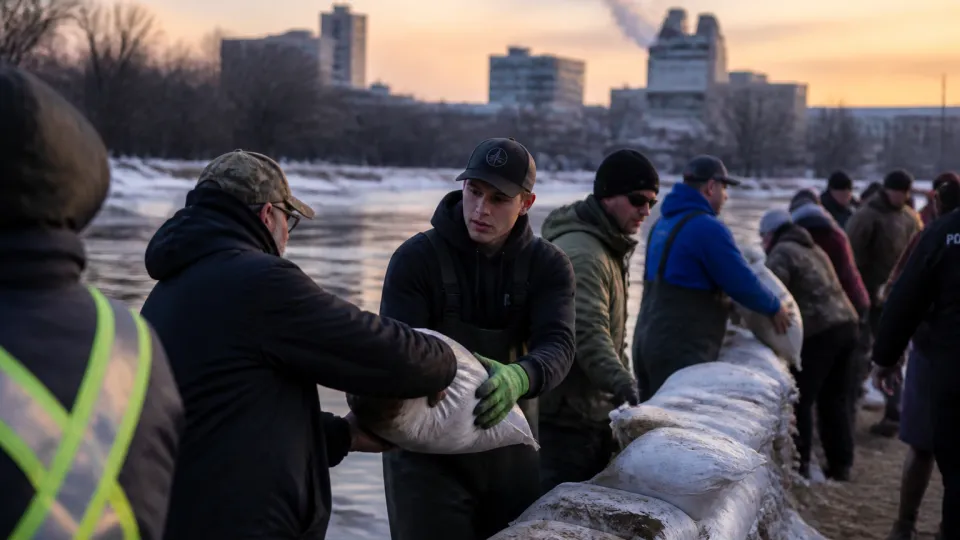
On a gray April morning, a line of people moved along the Assiniboine Riverbank, hoisting sandbags as if passing the weight of an entire season from hand to hand. Their breath hung like small clouds; their faces were of different ages, immigrant backgrounds and work histories. For those who live in Brandon, that chain of strangers doing ordinary labor for the common good feels less like an exception than an inheritance.
Volunteerism in Westman is not an abstract civic virtue. It is practical, granular and often inherited—learned in basements, church halls and high school cafeterias. Its history can be read in the hospital auxiliary thrift stores that once funded surgical equipment, in the volunteer fire brigades that preceded municipal services, and in the intergenerational clubs that stitched social life together after the railway arrived and the town grew in the late 19th century.
In the early years, volunteerism in Brandon and surrounding towns was stitched tightly to necessity. Farmers, tradespeople and railway workers formed mutual aid networks to handle crop failures, barn fires and medical emergencies. When the Brandon General Hospital expanded in the mid-20th century, much of the non-clinical work—fundraising for beds, running canteens, providing palliative support—fell to women’s auxiliaries and groups. The Royal Canadian Legion organized poppy campaigns that funded veterans’ services. Kinsmen and Rotary clubs took up playgrounds, scholarships and disaster relief.
These were not romantic gestures but civic plumbing—small acts that maintained public life when institutions were thin. The particular ethnic makeup of Westman—settled by Ukrainian, Mennonite and other immigrant communities—shaped forms of service. Language circles, harvest assistance and church-run food programs often functioned as both social safety net and cultural preservation.
Consider the hospital auxiliary that for decades ran the gift shop at the city hospital. Volunteers there were often the first human touch for families arriving at odd hours; they raised funds by selling baked goods and used furniture, and their accounts of the hospital’s needs shaped fundraising priorities. Or the student group at Brandon University that transformed a classroom into an emergency shelter during a local flood scare, coordinating bedding, food and outreach through social media. These are small interventions with outsized consequences—someone avoids an overnight bus ride, a parent is fed, a child is kept warm.
Volunteering also has provided a path to belonging for newcomers. Recent immigrant volunteers in community meal programs and language buddy initiatives report that service work accelerated their social networks and employment prospects, offering a practical way to translate skills and goodwill into local trust.
Yet the model that sustained Westman for generations is fraying. Demographic change means a larger share of potential volunteers are older; younger people juggle precarious work, study and digital lives. The pandemic exposed both the indispensable nature of volunteers and how fragile volunteer-driven services can be when public funding and paid staff withdraw. Burnout is common: long-running programs struggle to recruit committee chairs, and some once-reliable thrift store revenues have declined with online marketplaces.
At the same time, reinvention is underway. Organizations are experimenting with micro-volunteering—short-term, task-based commitments that appeal to busy professionals and students. Digital platforms help coordinate shifts for food banks and meal deliveries. Partnerships between Brandon University, Assiniboine Community College and local non-profits are formalizing placements that offer academic credit while meeting community needs. Newcomers now serve not only in informal mutual aid roles but also on boards, reshaping what local leadership looks like.
The future of service in Westman will be less about nostalgia for long-standing clubs and more about building infrastructure that supports volunteer labour—training, reimbursement for expenses, mental-health supports, and flexible role design. Municipal policies can help: coordinated volunteer registries, matching platforms, and small grants that reduce the administrative burden on grassroots groups.
Equally important is reframing volunteerism as a two-way street. When a retired mechanic teaches carpentry at a community-build project, the neighbourhood gains a repaired roof and the volunteer gains social connection and purpose. When a newcomer teaches language skills at a seniors’ centre, both sides build resilience.
The story of volunteerism in Brandon and the wider Westman region is not only about altruism; it is about the practical maintenance of civic life. These hands have filled gaps when state provision was thin and have knitted networks of care that make the region more livable. Preserving that legacy requires candid attention to who volunteers, why they stop, and what systems can sustain them.
If community service is to remain a foundation rather than a stopgap, it must be supported by modern systems—flexible roles, municipal coordination, and equitable inclusion of newcomers and youth. The sandbag line on the riverbank is more than a seasonal image; it is a reminder that civic resilience is made one small, steady act at a time. The question for Westman is whether those acts will be honored as part of a renewed public infrastructure, or left to whither under the rising weight they once alone were expected to carry.